
Hundreds of Pune residents have protested against the use of loud music and DJ systems during the upcoming Ganesh festival, citing health issues and noise pollution. Ganesh Mandals, however, claim selective targeting and have pledged to follow guidelines to reduce noise.

Vidyanand Bapat, a Pune-based activist advocating for a ban on high-decibel DJ systems and loudspeakers during festivals, was publicly assaulted by a man named Santosh Chavan while speaking to media persons.

The Bombay High Court has imposed a complete ban on firecrackers, loudspeakers, DJs, and laser beams on public roads during festival processions, criticising the Maharashtra government for its laxity in implementing noise pollution rules. The court highlighted the severe noise and air pollution caused by such celebrations and called for more dignified ways of observing festivals, noting that current permissions are often ineffective due to official inaction.

The Bombay High Court has issued a complete ban on bursting firecrackers on public roads and deemed the use of loudspeakers, DJs, and laser beams during religious processions "unwarranted." The court emphasized that festivals must be celebrated without causing noise and air pollution, highlighting the need for strict enforcement of existing regulations.

Since the allotted extra day could not be used during the Ganesha festival, it will be for Navratri.
Relaxation would be allowed during three Navratri nights, Patil said.

'Many devout religious people have told me categorically that they like celebrating festivals, but they are vehemently against the noise pollution and traffic obstruction that are being imposed under the pretext of celebrations.'

A seven-year-old girl in Balrampur, Uttar Pradesh, died after allegedly collapsing due to loud music from a Ganesh immersion procession. Two individuals, the DJ owner and operator, have been arrested, and a police officer suspended for negligence. The incident has led to a ban on DJs during upcoming festivals in the municipal area.

Before protesting against the State, the citizen should not have to ask: Sir, may I protest, please?, asserts Prem Panicker.
A bench headed by Chief Justice K G Balakrishnan refused to give an early hearing to the petition filed by a Pune-based Ganesh mandal, which pleaded that noise level up to 40 decibels be allowed.

'But they had nothing to negotiate as the government did not negotiate. It is completely the fault of the government as they dumped it on the police.'
Senior advocate Mukul Rohatgi, appearing for the Gujarat government sought the relaxation for two hours from 10:00 pm till midnight during the Navratras on the use of laudspeaker for the garba dance, for which the state is famous.
However, the Supreme Court said that the power to relax the ban could not be delegated by the state governments to other authorities.

The petition, filed by Bajrang Dal leader Shaktisinh Zala, claimed that "noise pollution" caused by azan when played through loudspeakers affects people's, especially children's health and causes inconvenience otherwise.

During this Ramzan, another religious practice was turned into an offence: Breaking the fast, or iftar.

Jayant Naiknavare, who took over as the Nashik commissioner of police last week, has cancelled the order given by his predecessor Deepak Pandey over loudspeakers.

'It is best to remain vigilant. Tarique Rahman arranged arms smuggling to Indian insurgent groups.' 'He has criticised India for sheltering Sheikh Hasina, but has also sought India's support.'
Loudspeakers cannot be used during the immersion of idols.

After the anti-halal meat drive, right-wing outfits led by Bajrang Dal and Sriram Sena have now called for a ban on loudspeakers in mosques.

Authorities in Leh, Ladakh, have imposed prohibitory orders under Section 163 of the Bharatiya Nagarik Suraksha Sanhita (BNSS) following violent protests demanding statehood for Ladakh and extension of the Sixth Schedule. The protests, led by the Leh Apex Body, resulted in the burning of the BJP office and vehicles, prompting the district magistrate to issue the order to maintain public order and tranquility.
Following the direction of the Uttar Pradesh government, nearly 11,000 loudspeakers have been removed from religious places till Wednesday evening.

It is the Hindu community that has faced the biggest setback as far as the issue of loudspeakers is concerned, the Sena MP added.

The move comes barely two days after the authorities lifted the restrictions in Leh, 22 days after they were first imposed following violent clashes during protests demanding statehood and Sixth Schedule Status that left four persons dead and 90 injured on September 24.

An editorial in Sena mouthpiece Saamana said the issue is of noise pollution and environment protection. 'The Centre should promulgate an ordinance to stop loudspeakers on mosques to prevent noise pollution,' it said.

At least 50 people were detained as police and paramilitary forces strictly implemented curfew on Thursday in the violence-hit Leh, where four people were killed and over 80 others were injured when widespread clashes broke out a day before.

"You have seen that in Islam, it is said that they oppose 'bootparastee' (idol worship). It is their matter and their philosophy. We perform idol worship. We worship the 'saakaar brahma' and the 'niraakaar brahma', which is allowed by the Sanatan Dharma.... Some are saying 'I Love Mohammad' and indulging in arson and vandalism." "They know that this is Sharadiya Navratra, the occasion of Vijaya Dashami. If they spread chaos during the Sharadiya Navratra, work like 'Chundd' and 'Mundd', then Goddess Bhagwati is not going to tolerate it. Goddess Bhagwati crushes such 'Chundd' and 'Mundd'," Adityanath said.

Residents of Montmartre in Paris are sounding the alarm over overtourism, fearing their picturesque hilltop neighbourhood could become the next Barcelona or Venice, as tourist numbers spike following last year's Olympic Games.
Since it is not compulsory to use loudspeakers for azaan, this will not violate the shariyat.
The RSS uses its resentment against mosques and loudspeakers to stoke anti-Muslim feelings among other Hindus, whenever it can, be it during riots, or before elections, says Jyoti Punwani.
The court also reiterated its earlier directive putting a ban on bursting of crackers late at night during Diwali and other festivals.

The ruling Jharkhand Mukti Morcha in Jharkhand wrote to the Election Commission on Friday night and demanded the suspension of internet services within 2 km radius of the counting centres, alleging that the Bharatiya Janata Party has deputed 'highly qualified' electronic experts from other states.

They also appealed to youth from the community not to play loud DJ music during the Eid al-Fitr celebration on May 2.

The Bombay high court said on Wednesday that if the use of loudspeakers and sound systems beyond permissible noise levels was harmful during the Ganesh festival then it also has the same effect during the Eid-e-Milad-un-Nabi processions.
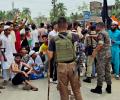
Protests against the Waqf (Amendment) Act turned violent in Cachar district of Assam on Sunday, with protesters throwing stones at police and the police using batons to disperse the crowd. The incident occurred in Berenga area of Silchar town where around 300-400 people protested without permission. The Cachar district administration imposed prohibitory measures across the district under Section 163 of the Bharatiya Nagarik Suraksha Sanhita (BNSS) to prevent further unrest. The order prohibits gatherings of five or more people without permission, carrying weapons, organizing protests, and traffic disruptions.
The apex court said that the sound system can be used by the organiser of Chhat puja for the crowd management and performance of rituals till 10 pm.

Following a stampede at New Delhi railway station and large crowds arriving for the Maha Kumbh, authorities in Uttar Pradesh have implemented stringent security protocols at key railway stations including Prayagraj, Varanasi, Ayodhya, Kanpur, Lucknow and Mirzapur. Measures include restricted entry, holding areas for passengers, increased security personnel, and improved facilities to prevent overcrowding.

To conserve the environment, the Akhara Council has decided to put a ban on the use of plastic items and loudspeakers at the venue of the ongoing Kumbh Mela in Nashik.
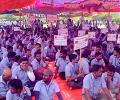
According to CITU, around 90% of the 1,723 workers of the Sriperumbudur plant are participating in the strike. Samsung said it is ready to talk to employees and not a third party like CITU.

The leader said he was not violating the Supreme Court's order banning the sale of firecrackers in Delhi-NCR this Diwali.

The order was issued on Thursday by the deputy commissioner of police (operations) in view of inputs received by the police about disturbance of peace, law and order, danger to human life and property, the official said.
